
Article map
Verdant News | Yield and production
How much can one hectare of Paulownia produce and what drives the final outcome
The question “how much can one hectare of Paulownia produce?” is one of the most common ones we receive from investors. The honest answer does not start from a single universal number. It starts from the factors that determine how much timber is produced, at what quality and under what conditions it can be monetized.
Next step
Want a concrete Verdant proposal for products or investment?
We can discuss your budget, operating model and product or plantation objectives, then come back with a clear next-step proposal.
What truly matters
Four variables that can radically change the result per hectare
Density and planting layout
The number of trees shapes potential volume, but it must match spacing, soil and monetization goals.
Consistent water availability
Without reliable water and properly designed irrigation, growth loses pace, uniformity and commercial value.
Yearly field work
Pruning, plantation control and maintenance influence shape and quality of the resulting timber.
Commercial market access
It is not enough to grow wood; what matters is how much enters higher-value commercial categories.
The right question
What “production per hectare” really means
Many investors search for a single number. In practice, production per hectare should be viewed through three layers: how many trees are integrated into the model, how much usable volume develops over time and how much of that volume reaches a quality level that can be sold profitably.
That is why Verdant does not treat the hectare as a simplistic formula. We look at density, water, infrastructure, monitoring and the way plantations are managed year after year. Those factors influence the final result much more than a generic marketing estimate.
Biological output
What drives growth and timber mass
The first group of variables is biological and operational: soil profile, climate, water availability and the rhythm of field work. When water is secured and the plantation is followed closely, trees can develop more uniformly and with better predictability.
That is exactly why we encourage partners to implement irrigation from the start. Irrigation is not just a technical accessory. It shifts the plantation from a position of vulnerability to one of better control, which can directly affect both timber quality and consistency.
- per-hectare density and planting layout;
- the stage at which the investor enters the model;
- water availability and irrigation infrastructure;
- pruning and shaping interventions;
- consistency of yearly execution and responsiveness in the field.
Value, not only volume
Why more wood alone is not enough
Production per hectare must be matched with the market segment into which the timber can be sold. A hectare that yields volume but at modest commercial quality is not equivalent to a hectare that can supply better processing channels and higher-value products. Investors should understand that difference from the beginning.
In an integrated project, value improves when the plantation is managed in a way that helps move timber toward better applications. That is where not only biological output matters, but also the operator’s ability to commercialize and process effectively.
Verdant conclusion
How investors should read this question
The healthy question is not only “how much can one hectare of Paulownia produce?” but also “under what conditions can it produce well, and who controls those conditions?”. For the investor, the useful answer is tied to water, irrigation, maintenance and to how the operator takes the plantation all the way to monetization.
In Verdant, the investor joins as a capital partner while we manage execution. That makes the question of per-hectare output more meaningful, because it is connected to real operating processes rather than abstract promises.
Yield FAQ
Frequently asked questions about yield per hectare
Is there a universal output figure for one hectare of Paulownia?
No. The result depends on density, water, irrigation, yearly work and on how the timber is ultimately commercialized.
Why does Verdant place so much emphasis on water?
Because water directly influences growth rate, plantation uniformity and the chance of achieving timber quality suitable for better-value market segments.
Does tree count matter more than management quality?
Both matter, but without management and irrigation, tree count alone does not guarantee a good economic outcome.
How should an investor compare two different plantation projects?
Not only by density or area, but by infrastructure, water, operator quality, yearly discipline and the route to timber monetization.
More from Verdant
Related articles that support the decision process
What an investor actually buys in the Verdant plantation: trees, infrastructure or a complete operating model?
We clarify what sits inside the Verdant investment model: not only trees, but irrigation, maintenance, annual operations and a full monetization path.
Read article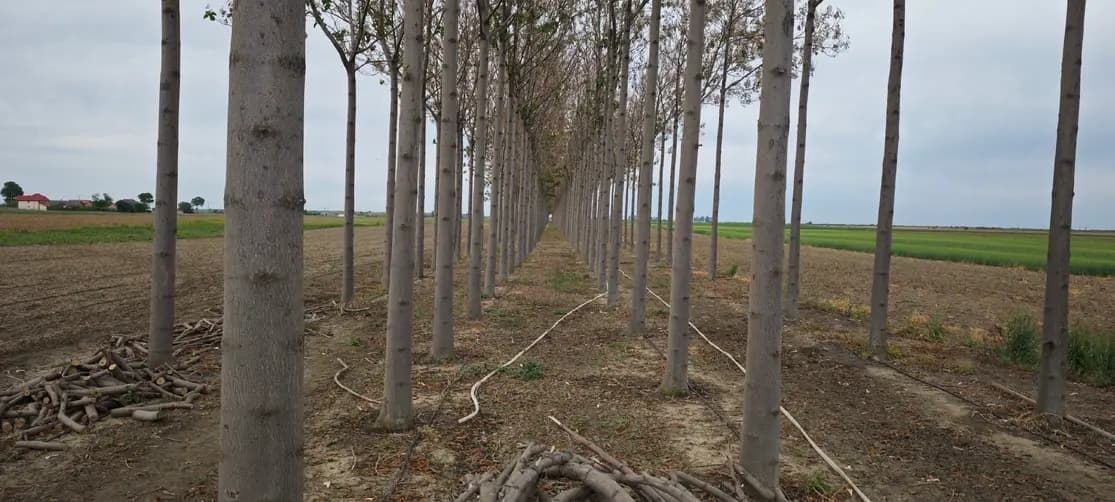
Why investors seek real assets: Paulownia, farmland and inflation protection
We examine why capital looks for assets anchored in the real economy and how a professionally operated plantation fits that discussion.
Read articleHow to reduce risk in a Paulownia investment: water, maintenance, management and monetization
A practical article for investors who want to understand where real risks appear and how they can be reduced in a well-operated project.
Read article
Social media
Verdant on Instagram and YouTube
Instagram
View profileVerdant Instagram gallery
A curated stream of our latest visuals from Instagram activity.
YouTube
View channel